
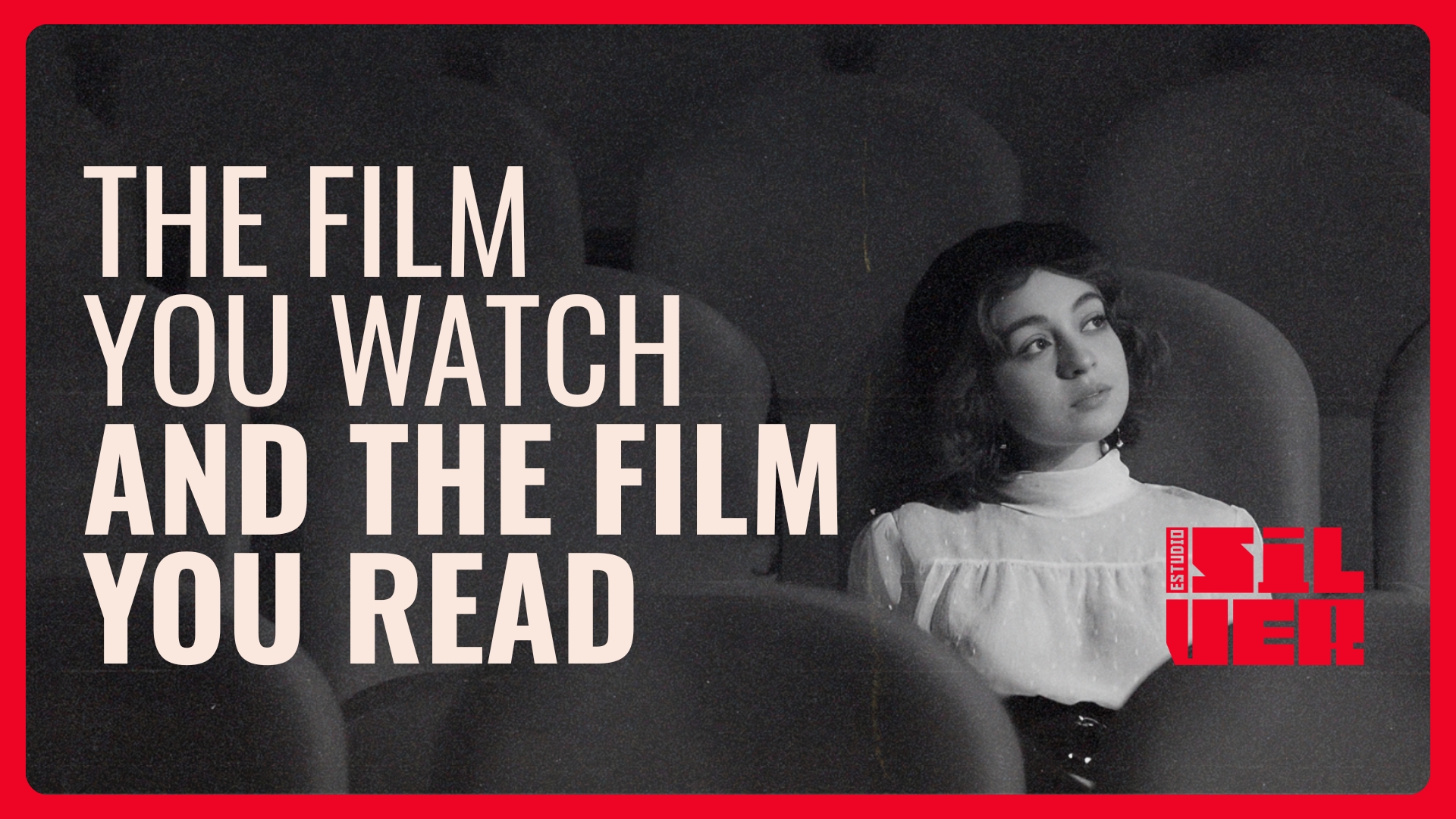
Watching a film through its subtitles redefines the experience. Subtitles—like the camera—focus, frame, direct attention, and underline. Between watching and reading, the experience flows to the rhythm of the montage.
By Ariana V. Loker
Traveling and connecting with diverse audiences is an ambition shared by all films, big and small. The audiovisual text consists of three layers of meaning active simultaneously: image, sound, and dialogue, and while translation intervenes in only one of them—the dialogue—it is anchored in all the rest.
A delicate process occurs in the translation of dialogue. What was originally an experience of shared meanings, connotations, and more or less transparent references in a language and culture becomes dependent on mediation. And that mediation is not neutral.
Subtitling involves deciding what goes in and what stays offscreen. In a sense, the work resembles that of the camera, which focuses, crops, directs attention, and highlights. Every subtitle is an intervention in the viewer’s experience.
When a film is presented at an international festival, the jury doesn’t just watch it: they also read it. When the foreign press quotes a line, they will likely quote its translation. And when foreign audiences are moved, laugh, or feel uncomfortable with a line, that emotion has passed through the translator’s subjectivity.
The screen is divided between watching and reading
In a subtitled film, the visual experience changes. Eye-tracking studies show that the bottom third of the screen—the space where subtitles appear and disappear—concentrates most of the attention. The experience becomes bifocal: we read and watch at the same time.
That is why subtitles cannot hinder the experience. They must integrate with the images, follow the rhythm of the editing, keep pace with the shot changes, and allow time for the viewer’s gaze to take in the rest of the composition.
Well-designed subtitles do not compete with the film: they flow with it and become part of the immersive experience.
Translation is the transfer of phrases, but it is also cultural adaptation within a specific context
Every script is marked by precise word choices: the wit of a phrase, the barely hinted disdain in a gesture or tone, the heaviness of an atmosphere, a character’s particular sense of humor… When a film is translated, those decisions are made again through the lens of cultural differences.
Audiovisual translation is limited by the space and time constraints of subtitles: two lines and three or four seconds to read them. Dialogue is not autonomous; it functions within a complex web of meaning. We work with all those layers simultaneously.
There is truth in fiction
We keep watching a film after the first twenty minutes because something clicks. We recognize something of ourselves on the screen. We seek to understand the world. And to understand ourselves.
In what is shown.
In what is said.
And in how it is said.
Translation is part of that connection. It can facilitate it or interfere with it. It can preserve the original tone or flatten it. It can uphold an intention or shift it.
At Estudio Silver, we approach each project as a unique universe
Before translating, we watch the film or read the script and take notes. We identify ambiguities, research references, and consult with the writers or directors.
For subtitles, we create a timed master template using licensed software that allows us to control technical parameters. A translator from our team works on the translation. Finally, we perform linguistic and technical reviews in a playback to deliver the necessary formats for DCP compilation, screening, or delivery to digital platforms.
If you’d like to learn more about the criteria and process we apply to each project, you can get a glimpse of our approach by downloading the following document for free:
Translation and Subtitling for Independent Film: Basic Principles
At Estudio Silver, we understand that subtitles are a film’s window to the world. And our hope is that good stories reach far and wide.